
Mindful of this, the school strives to provide students with the tools to make the most of the reading experience, ensuring first of all that contact with reading begins at an early age.
Our library becomes the main space where access to information is made available, from kinder to middle school, through age-appropriate material.
Language and knowledge have gone hand in hand as a fundamental part of the history of humankind. In the teaching-learning process everything begins with the innate sense of exploration. But how do we help young children develop an interest and curiosity for reading? The answer is simple:
Let us start by fostering their sense of wonder, putting within their reach materials that help the child explore books, leafing through them with ease, taking into account the following steps:
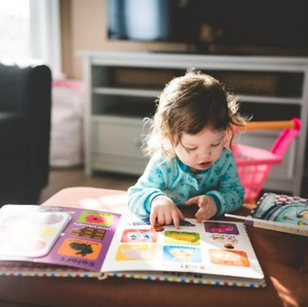
Young children's first contact with reading (6 months to 4 years) comes through board books with thick pages, and also cloth books; these allow children to get used to handling books. It is recommended that they contain colorful images and simple characters that familiarize the child with language, sounds and images; in this way, attention is focused on one objective and the skill of concentrating on images develops. In this first encounter, their learning is based on pictograms.
For little ones aged 4 to 6, it is advisable to look for books with little text and large images that tell a story; for those who cannot read yet, this gives the child the freedom to leaf through the book while the adult reads the sentences aloud, awakening interest in getting to know the story and beginning the process of decoding words and spelling in a friendly way.
Children between 7 and 10 years or older have already built their reading ability; at this point the goal is to help the child develop reading skills by practicing every day so they achieve the reading habit and perhaps eventually a fondness for it. Ask them to read aloud — this will help them develop their memory, fluency and reading speed. It is fine to use a visual guide as support, so that if they look up it is easier to return to the text.
While technology is indeed a great tool, for first readers it is not advisable to replace printed reading, since books allow the child to have direct contact with the object and make reading more comfortable.
Read aloud together with them: the idea is that the child reads first and then listens to you, emphasizing key words — this helps them give intonation to words and better understand the text, and it also becomes an excellent opportunity to share a moment together.
It is important to choose texts well, with appealing topics that are of interest to the child, keeping in mind that it should be short so they do not lose interest or feel too lazy to read, so that they can read the text several times until they achieve fluent reading.
The school offers more tools to promote reading, such as the Reading Club and the Book Fair, where our community can find a great variety of fun, enriching activities that make reading an unforgettable moment.
Recent postsSee allThe Importance of Sports in Well-Rounded Development at School Collaborative Work in the Classroom By: Natalia Varela Inclusive Education SUBSCRIBE TO OUR BLOG AND STAY UP TO DATE WITH OUR NEWS